Learning pronouns in English makes sentences shorter, clearer, and easier to understand. Pronouns, grammar rules, and sentence examples help learners replace nouns correctly. This builds a strong grammar foundation for everyday English. You’ll learn each rule through simple examples and clear pictures. Every explanation stays focused on English grammar, making each concept easier to remember and apply correctly.
Table of Contents
What are Pronouns in English Grammar?
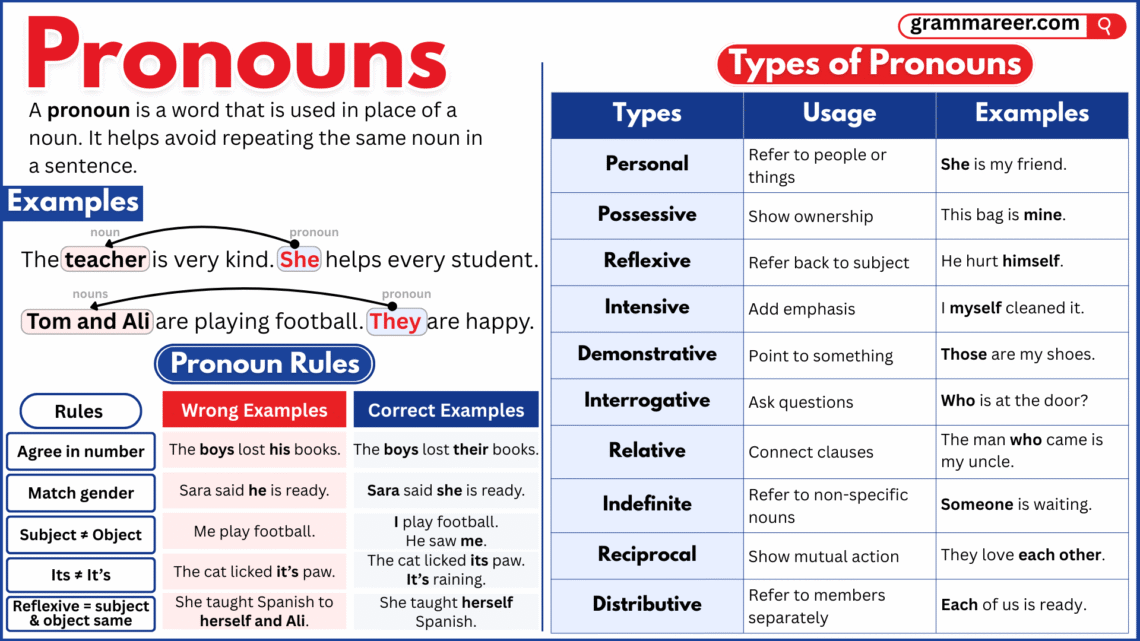
Pronouns are words that replace nouns in a sentence. They prevent repeated use of the same noun and make writing smoother. A pronoun refers to a person, place, thing, or idea already mentioned or understood. Learning pronouns is a basic step in English grammar because they appear in almost every sentence.
For example, instead of repeating Sarah, you can use she. Instead of repeating the books, you can use they.
Rule
A pronoun replaces a noun without changing the sentence’s basic meaning.
Formula
Noun → Pronoun
- Emma is reading. → She is reading.
- The dogs are barking. → They are barking.
5 Examples of Pronouns for Clarity
These examples show how pronouns replace nouns naturally.
- Ali is my friend. He likes football.
- Sara has a new bicycle. She rides it daily.
- The students finished the test. They looked happy.
- The laptop is expensive. It works very fast.
- My parents are traveling. They will return tomorrow.
Pronouns are commonly classified into three groups by person.
| Person | Singular Pronoun | Plural Pronoun |
| First Person Pronoun | I, Me | We, Us |
| Second Person Pronoun | You, Your | You |
| Third Person Pronoun | He, She, It, Him, Her | They, Them, Their |
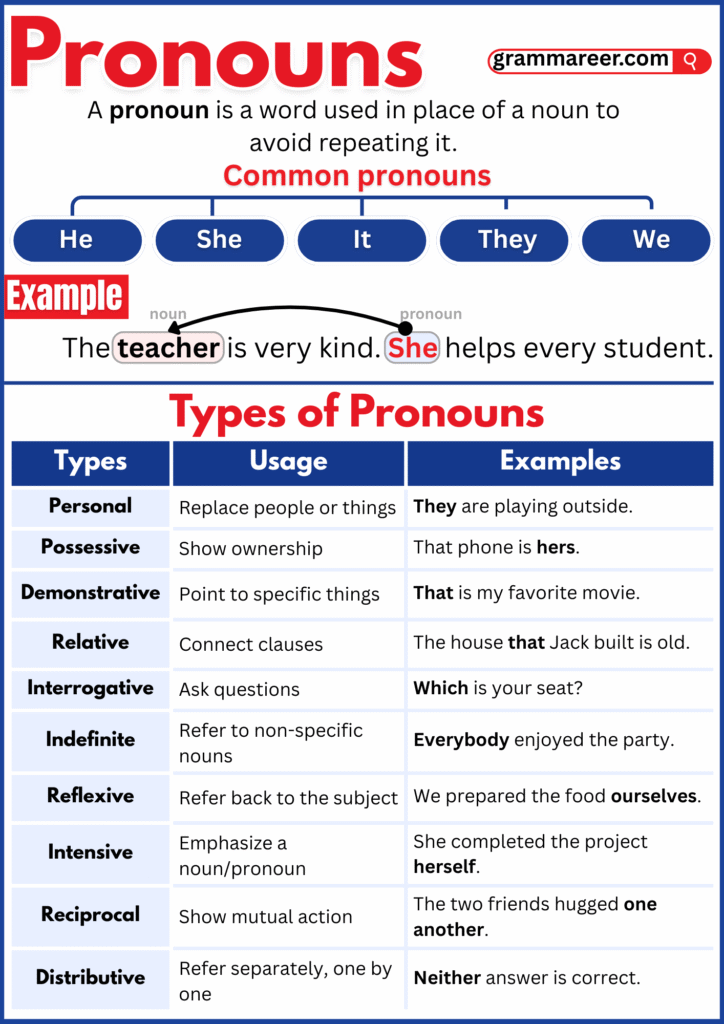
10 Types of Pronouns and Definition with Examples
English grammar has different types of pronouns. Each type has a specific job in a sentence. Learning these types makes it easier to choose the correct pronoun while speaking and writing.
1. Personal Pronouns
Personal pronouns replace the names of people, animals, places, or things. They change according to the subject or object in a sentence.
Subject Personal Pronouns
| Singular | Plural |
|---|---|
| I | We |
| You | You |
| He | They |
| She | |
| It |
Object Personal Pronouns
| Singular | Plural |
|---|---|
| Me | Us |
| You | You |
| Him | Them |
| Her | |
| It |
Examples
- I enjoy reading every morning.
- You answered every question correctly.
- He plays cricket on weekends.
- She loves painting.
- It needs more water.
- The teacher praised us.
- Please call me tonight.
- I invited them to dinner.
2. Possessive Pronouns
Possessive pronouns show ownership. They replace a noun and indicate who owns something.
Common Possessive Pronouns
Mine, Yours, His, Hers, Ours, Theirs
Examples
- This bag is mine.
- The blue bicycle is yours.
- That jacket is his.
- The decision was hers.
- The classroom is ours today.
- Those books are theirs.
3. Reflexive Pronouns
Reflexive pronouns refer back to the subject. The subject and object are the same person or thing.
Reflexive Pronouns List
- Myself
- Yourself
- Himself
- Herself
- Itself
- Ourselves
- Yourselves
- Themselves
Examples
- I taught myself to cook.
- She introduced herself.
- He blamed himself.
- The cat cleaned itself.
- We enjoyed ourselves.
- They prepared themselves well.
Rule
Use a reflexive pronoun only when it refers back to the subject.
4. Demonstrative Pronouns
Demonstrative pronouns point to specific people or things.
Demonstrative Pronouns
- This
- That
- These
- Those
Usage
| Pronoun | Use |
|---|---|
| This | One thing near the speaker |
| That | One thing far from the speaker |
| These | More than one nearby |
| Those | More than one farther away |
Examples
- This is my notebook.
- That belongs to Ali.
- These are fresh oranges.
- Those were expensive shoes.
- This looks better.
- Those need cleaning.
5. Relative Pronouns
Relative pronouns connect a noun with extra information. They introduce relative clauses.
Common Relative Pronouns
- Who
- Whom
- Whose
- Which
- That
Examples
- The boy who won smiled proudly.
- The teacher who helped me retired.
- The woman whose purse was missing called the police.
- The book that I borrowed was excellent.
- The car which you bought looks new.
- The student whom I met was friendly.
Rule
Choose the relative pronoun according to the noun it refers to.
- Who → people
- Whom → object form for people
- Whose → possession
- Which → animals and things
- That → people, animals, or things in many situations
6. Interrogative Pronouns
Interrogative pronouns are used to ask questions. They stand in place of the noun you want to know about.
Common Interrogative Pronouns
- Who
- Whom
- Whose
- Which
- What
Examples
- Who is your science teacher?
- Whom did you invite?
- Whose backpack is this?
- Which do you prefer?
- What happened yesterday?
- Who answered the question first?
- Which is your favorite book?
- What made you smile?
Rule
Use the correct interrogative pronoun based on the information you are asking for.
| Pronoun | Used For |
|---|---|
| Who | Subject (person) |
| Whom | Object (person) |
| Whose | Ownership |
| Which | Choice between known options |
| What | Things, ideas, or information |
7. Indefinite Pronouns
Indefinite pronouns refer to people or things without naming them specifically.
Common Indefinite Pronouns
- Someone
- Somebody
- Anyone
- Anybody
- Everyone
- Everybody
- Nobody
- No one
- Something
- Anything
- Everything
- Nothing
- Several
- Many
- Few
- All
- Some
- Most
- None
- Each
Examples
- Someone is waiting outside.
- Everybody enjoyed the concert.
- Nobody knew the answer.
- Anything is possible with practice.
- Everything looks clean.
- Nothing was damaged.
- Several arrived early.
- Each received a certificate.
Rule
Some indefinite pronouns are singular, while others are plural.
| Singular | Plural |
| Everyone | Many |
| Someone | Several |
| Anybody | Few |
| Nobody | Both |
What is an Antecedent?
Before we can use a pronoun, we usually have to mention the noun it refers to. That noun is called the antecedent.
Think of it this way: a pronoun is like a nickname, and an antecedent is the real name. First you introduce the real name, then you can use the nickname.
Examples:
- Ali has a bike. He rides it every day.
- The book is on the table. Can you pass it to me?
- My friends are kind. I enjoy spending time with them.
Here, the underlined nouns (Ali, book, my friends) are the antecedents, and the bold words (he, it, them) are the pronouns.
Sometimes, you don’t need an antecedent. Words like I, you, we, and me are clear on their own because everyone already knows who they refer to.
So, in short: an antecedent is simply the noun that a pronoun replaces.
How Are Pronouns Used in a Sentence?
The main job of a pronoun is to take the place of a noun. Because of this, pronouns are used in sentences just like nouns.
Pronouns as subjects
Most of the time, pronouns act as the subject of a sentence. That means they come before the verb.
Examples(Pronouns as subjects):
- I love reading books.
- We are going to the market.
- It looks like it might rain.
Pronouns as objects
Pronouns can also be used as the object in a sentence. The object is the person or thing that the action happens to.
Examples(Pronouns as objects):
- Can you help me?
- She called him yesterday.
- The teacher gave us homework.
So, whether as a subject or an object, pronouns keep our sentences clear and natural without repeating the same nouns again and again.
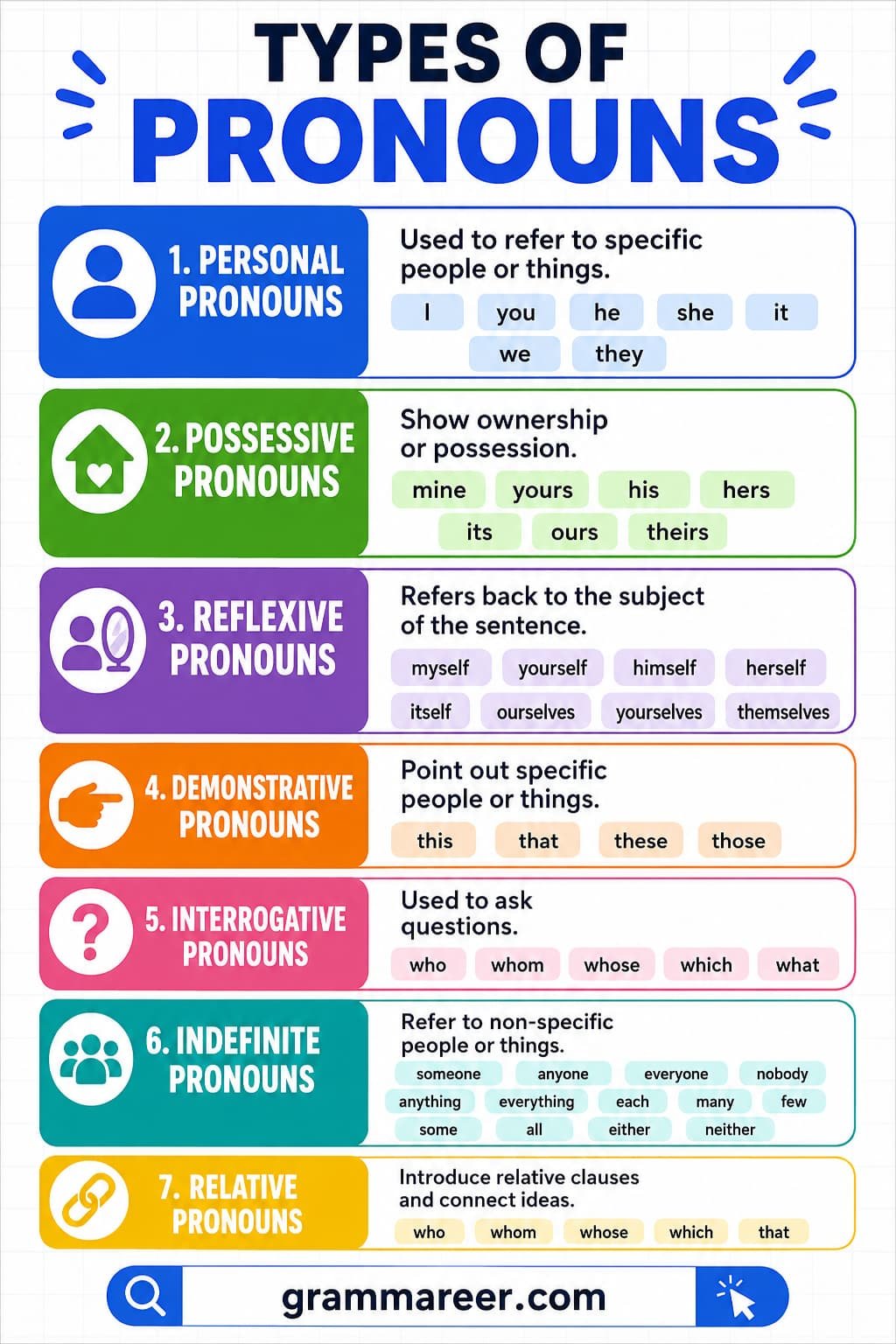
Types of Pronouns with Chart
Types of pronouns in English show the different ways we use pronouns in sentences. Each type has its own role—sometimes replacing a noun, sometimes pointing to someone or something. Let’s break them down:
| Type | Explanation | Examples | In a Sentence |
| Personal Pronouns | Used to refer to people or things directly. | I, you, he, she, it, we, they | • I love reading. • They are my friends. |
| Possessive Pronouns | Show ownership. | mine, yours, his, hers, ours, theirs | • That book is mine. • This house is ours. |
| Reflexive Pronouns | Point back to the subject. | myself, yourself, himself, herself, itself, ourselves, themselves | • She taught herself Spanish. |
| Demonstrative Pronouns | Point to something specific. | this, that, these, those | • This is my bag. • Those are old photos. |
| Relative Pronouns | Connect clauses and add info. | who, whom, which, that, whose | • The girl who won is my cousin. |
| Indefinite Pronouns | Refer to non-specific people/things. | someone, anyone, everyone, nobody, each, few, many | • Someone is at the door. • Many were absent. |
| Interrogative Pronouns | Used to ask questions. | who, whom, what, which, whose | • Who is your teacher? • Which is your bag? |
| Reciprocal Pronouns | Show mutual action/feeling. | each other, one another | • They respect each other. |
| Intensive Pronouns | Add emphasis to the subject. | myself, yourself, himself, herself, itself, ourselves, themselves | • I baked this cake myself. |
| Distributive Pronouns | Refer to members individually. | each, either, neither, none | • Each student got a book. • Neither answer is correct. |
Pronoun vs Personal Pronoun
All personal pronouns are pronouns, but not all pronouns are personal pronouns. A pronoun is a broad grammar category that includes many types, while a personal pronoun specifically replaces the names of people, animals, places, or things.
| Feature | Pronoun | Personal Pronoun |
|---|---|---|
| Meaning | A word that replaces a noun | A type of pronoun that replaces a noun directly |
| Scope | Includes all pronoun types | Includes only personal pronouns |
| Purpose | Performs different grammar functions | Refers to a specific person, place, animal, or thing |
| Examples | Who, This, Mine, Someone, Each | I, You, He, She, It, We, They, Me, Him, Her |
Pronoun vs Adjective with Examples
Pronouns and adjectives may look similar, but they have different jobs. A pronoun replaces a noun, while an adjective describes or modifies a noun.
Difference Between Pronoun and Adjective
| Feature | Pronoun | Adjective |
| Function | Replaces a noun | Describes a noun |
| Comes Before a Noun | Not always | Usually yes |
| Can Stand Alone | Yes | No |
| Main Purpose | Avoids repetition | Gives more information about a noun |
Noun vs Pronouns
A noun names a person, place, thing, or idea. A pronoun replaces that noun to avoid repeating it.
Difference Between Noun and Pronoun
| Feature | Noun | Pronoun |
| Meaning | Names a person, place, thing, or idea | Replaces a noun |
| Repetition | May repeat often | Prevents repetition |
| Examples | Ali, school, table, honesty | He, she, it, they, we |
Why are Pronouns Important?
We need pronouns because they make our sentences easier to say and understand. Without them, our speech and writing would feel long, repetitive, and a bit awkward. Pronouns keep things simple, natural, and clear.
FAQs about Pronouns in English
A pronoun is just a word we use instead of a noun so we don’t keep repeating the same word again and again.
We use pronouns to make our sentences smoother and less repetitive. Without them, our writing and speaking would sound clumsy.
There are different types, like personal pronouns, possessive pronouns, reflexive pronouns, demonstrative pronouns, and more. Each type has its own job in a sentence.
Yes, very! They help us talk more clearly and naturally. Imagine saying someone’s name again and again—it would sound odd. Pronouns make language easier.
Absolutely. The form of a pronoun can change depending on whether it’s the subject, object, or showing possession.
You May Also Like